
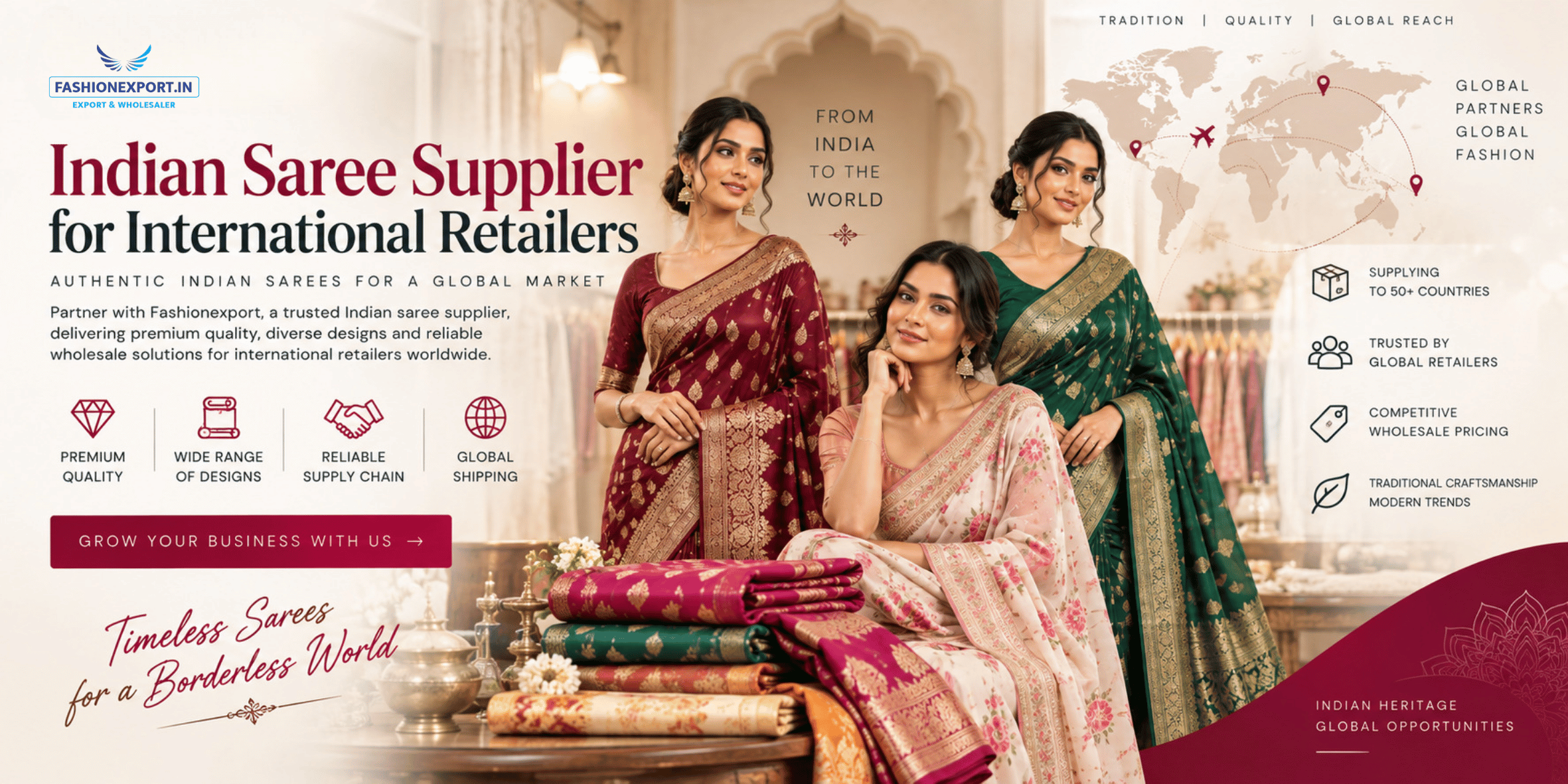
International fashion businesses are increasingly exploring Indian ethnic wear to add distinctive products to their retail collections. Fashionexport provides an Indian fashion sourcing option for businesses interested in wholesale clothing and Indian fashion products. If you are searching for an Indian Saree Supplier for International Retailers, it is important to evaluate more than product appearance. Fabric quality, design variety, wholesale pricing, order quantities, customization, packaging, production capacity, communication, and delivery planning can all influence the success of a retail collection. Businesses can visit the Fashionexport website at Fashionexport to explore Indian fashion sourcing opportunities.
Indian sarees have a distinctive position within the global ethnic fashion market. The saree can be traditional, contemporary, minimal, highly embellished, printed, embroidered, lightweight, premium, or designed specifically for an occasion. This flexibility allows international retailers to create collections for different customer groups and price points.
An Indian Saree Supplier for International Retailers is a supplier or fashion business in India that provides sarees to businesses operating outside or across international markets. These buyers may include boutiques, ecommerce stores, department stores, distributors, wholesalers, fashion brands, importers, and ethnic clothing retailers.
The relationship between an international retailer and an Indian supplier generally involves commercial product sourcing rather than individual retail purchasing.
A wholesale buyer may need to discuss:
The exact process depends on the supplier, product, order size, and destination market.
India has a broad textile and apparel manufacturing ecosystem. Sarees are produced in numerous fabrics and design categories, making them suitable for different retail strategies.
International retailers can use Indian sarees to expand categories such as:
The variety of Indian saree designs gives retailers the flexibility to build specialized collections instead of offering only one style.
Demand for Indian sarees can vary significantly between markets.
A retailer serving a South Asian customer base may focus on traditional designs and culturally familiar fabrics. Another retailer serving a broader international audience may prefer contemporary colors, lightweight fabrics, modern prints, and simple styling.
The retailer should therefore understand its customer before selecting the collection.
Useful questions include:
These questions can guide the sourcing process.
A diversified Indian Saree Supplier for International Retailers may offer several product categories.
Printed sarees can be suitable for everyday, casual, semi-formal, and fashion-oriented collections.
Prints may include:
Printed sarees can also provide an accessible entry point for customers who are new to Indian ethnic fashion.
Embroidery adds decorative detail and can create a more premium appearance.
Embroidered sarees may be positioned for:
The embroidery can be concentrated on the border, pallu, blouse piece, or distributed across the saree.
Festive sarees can use vibrant colors, traditional motifs, decorative borders, embroidery, prints, and embellishments.
International retailers can create seasonal categories around festivals and cultural celebrations relevant to their customer base.
Party wear collections can include fabrics with shine, embellishments, sequins, embroidery, metallic details, or contemporary patterns.
These sarees can be positioned for evening events, parties, receptions, celebrations, and special occasions.
Traditional sarees can appeal to customers seeking culturally familiar designs, classic colors, heritage-inspired motifs, and traditional styling.
Contemporary sarees can combine the traditional saree silhouette with modern colors, minimal decoration, unusual prints, lightweight fabrics, and current fashion influences.
These products may appeal to younger shoppers and customers who want ethnic clothing with a modern appearance.
Fabric is one of the most important factors when working with an Indian Saree Supplier for International Retailers.
The appropriate fabric depends on the target market, climate, occasion, price range, and desired appearance.
Georgette is often used for lightweight fashion sarees. It provides a flowing appearance and can work well with prints, embroidery, embellishments, and contemporary designs.
Chiffon is lightweight and creates a soft drape. It can be suitable for party wear, evening wear, and elegant fashion collections.
Crepe can offer a smooth appearance and structured drape depending on its construction. It can be used for everyday, semi-formal, and occasion-oriented products.
Satin can create a polished and visually smooth appearance. Satin sarees may work well in party wear and contemporary fashion collections.
Cotton sarees can appeal to customers looking for breathable and comfortable clothing.
Cotton and cotton-blend products may be particularly relevant for warmer climates or casual collections.
Rayon and viscose can provide soft drape and comfort while supporting commercially accessible collections.
Organza has a lightweight and structured character. It can create a sophisticated appearance and work well in contemporary and occasion wear.
Silk and silk blends can provide a more premium or traditional appearance. These products can be positioned for weddings, celebrations, festivals, and special occasions.
International retailers should avoid selecting products randomly.
A strong collection can combine:
This creates a collection that serves different shopping occasions.
Color can strongly influence the commercial appeal of a saree.
A retailer can consider:
Black, white, red, navy, maroon, green, beige, cream, and pink can provide evergreen options.
Pastel pink, lavender, mint, powder blue, peach, and similar shades can support contemporary collections.
Emerald, ruby, sapphire-inspired blue, deep purple, and rich maroon can work well for festive and occasion collections.
Beige, ivory, cream, taupe, grey, and similar shades can support minimalist fashion.
A balanced collection can include several color groups rather than depending entirely on one trend.
Embellishment can influence both the appearance and price of a saree.
Common details include:
International buyers should inspect embellishments carefully because loose or poorly attached decorative elements can affect product quality.
The border is often one of the most visible design elements.
A simple border can create a minimalist look, while a broad embroidered or decorative border can make the saree more suitable for festive or formal occasions.
Retailers can create variety through:
Different retail businesses require different product strategies.
Boutiques often need differentiated designs that help create a distinctive assortment.
They may focus on:
Online stores need products that photograph well and have clear descriptions.
Useful product information includes fabric, color, pattern, embellishment, length, blouse information, occasion, and care instructions.
Larger retailers may require consistent supply, standardized product information, packaging, barcode or labeling requirements, and dependable production schedules.
Ethnic fashion retailers may combine traditional and contemporary collections depending on their customer base.
Wholesale purchasing should be based on realistic demand.
An international retailer can review:
This information can help determine how many products to purchase.
Minimum Order Quantity, commonly called MOQ, is an important consideration for international buyers.
MOQ can vary depending on:
A retailer should confirm MOQ before finalizing the collection.
Questions to ask include:
Clear answers can simplify order planning.
Samples are particularly useful when purchasing customized products.
A sample can help a retailer evaluate:
If the sample is approved, buyers should maintain the approved specifications as the reference for bulk production.
Quality control is essential when purchasing wholesale sarees.
A retailer should look for:
The quality standard should be communicated before production.
An international order may travel through multiple transportation and handling stages.
Suitable packaging can help protect sarees from:
Buyers should discuss individual packaging, outer cartons, labels, tags, and customized packaging where necessary.
Premium collections may require more presentation-focused packaging, while commercial everyday collections may use practical packaging designed to control costs.
A retailer working with an Indian Saree Supplier for International Retailers may be interested in private labeling.
Private labeling can allow a business to sell products under its own brand.
Possible requirements include:
The availability of private labeling depends on supplier capabilities and order requirements.
Some retailers prefer to create collections that reflect their own brand identity.
Customization may involve:
The more detailed the customization, the more important it becomes to document specifications clearly.
Wholesale pricing should be evaluated alongside the complete landed cost.
Potential costs include:
A retailer should calculate these costs before determining the final retail price.
A useful retail collection can contain multiple price levels.
Printed or minimally decorated sarees can provide accessible options.
Embroidered, better-finished, or more detailed products can occupy the middle category.
Highly detailed embroidery, premium fabrics, elaborate embellishment, and occasion-focused designs can support higher retail positioning.
This tiered approach allows retailers to serve customers with different budgets.
Seasonal planning is important for international fashion businesses.
Retailers can plan separate collections for:
Climate should also be considered. Lightweight fabrics may be more suitable for warm markets, while richer fabrics can be positioned for cooler seasons or indoor occasions.
Wedding fashion can be an important category for saree retailers.
A wedding collection may include:
Retailers can organize products around different wedding events and customer budgets.
Festive collections can focus on color, decoration, traditional inspiration, and occasion-focused styling.
Retailers can promote these products through:
Instagram is particularly useful for fashion businesses because sarees are highly visual products.
A retailer can use Instagram to display:
Reels can demonstrate movement and drape, while carousel posts can show several details of the same product.
Professional photography can make it easier for international customers to evaluate products.
A saree product listing can include:
Consistent photography across the entire collection creates a professional ecommerce presentation.
Search engine optimization can help retailers reach customers actively searching for Indian sarees.
Useful keyword themes include:
Content should answer genuine customer questions instead of relying on excessive keyword repetition.
Content intended for modern search experiences should be easy to scan and understand.
Useful elements include:
For example, a page answering "How do international retailers buy sarees from India?" should clearly explain supplier selection, samples, MOQ, pricing, customization, quality control, packaging, shipping, and documentation.
International buyers may not physically inspect products before placing an order.
Detailed specifications can reduce uncertainty.
Useful specifications can include:
The exact specifications should match the product being sold.
International retailers looking for Indian sarees need a sourcing strategy that considers product quality, customer preferences, pricing, collection variety, customization, packaging, and supply planning.
Choosing an Indian Saree Supplier for International Retailers can be an important step toward building a structured ethnic fashion category. However, supplier selection should be based on complete commercial requirements rather than product photographs alone.
Fashionexport provides an option for businesses exploring Indian fashion and wholesale clothing opportunities. Retailers can use the Fashionexport website to learn more about the company's offerings and assess whether its products and sourcing capabilities align with their business requirements.
A successful international saree collection can combine everyday products, festive styles, wedding sarees, party wear, contemporary designs, traditional products, and premium collections. The exact mix should depend on the retailer's customers, market, pricing strategy, and seasonal demand.
In Part 2, the guide will cover international sourcing processes, export planning, supplier evaluation, private-label development, sustainability, digital marketing, buyer mistakes, inventory management, long-term supplier relationships, FAQs, and a practical wholesale buying checklist.
International retailers looking to build an Indian ethnic wear collection need a sourcing process that goes beyond selecting attractive products. Product consistency, communication, pricing, quality control, packaging, production planning, and delivery all influence the success of a wholesale fashion business. Working with an Indian Saree Supplier for International Retailers can give boutiques, ecommerce stores, wholesalers, distributors, and fashion brands access to a wide range of Indian saree collections while allowing them to develop products according to their target market.
Fashionexport is an Indian fashion company that can be explored by international businesses looking for Indian clothing and wholesale fashion opportunities. Retailers can visit the Fashionexport website at Fashionexport to learn more about its fashion offerings and sourcing opportunities.
The international sourcing process generally begins with identifying the type of products required.
A retailer may start by defining:
Once these requirements are clear, the buyer can approach suitable suppliers and request product information.
The next stage may involve reviewing catalogs, selecting products, requesting samples, confirming specifications, discussing prices, finalizing quantities, and arranging production or dispatch.
A structured process can make wholesale purchasing easier to manage.
Selecting a suitable Indian Saree Supplier for International Retailers requires evaluating several areas simultaneously.
Review whether the supplier offers enough variety to support your target market.
A retailer may require:
Evaluate fabric, stitching, embroidery, borders, embellishments, finishing, and packaging.
If the retailer expects repeat orders, production capacity can become important.
Check whether the supplier can support required colors, designs, labels, packaging, and other custom requirements.
Clear communication is essential when products are being sourced internationally.
Understand MOQ, payment terms, sample requirements, lead times, and shipping arrangements before confirming an order.
A practical supplier checklist can help buyers compare potential partners without focusing only on price.
| Area | What to Check |
|---|---|
| Product Range | Designs, fabrics and categories |
| Quality | Fabric and finishing consistency |
| MOQ | Minimum quantity requirements |
| Customization | Colors, designs and branding |
| Production | Capacity and lead time |
| Packaging | Individual and bulk packaging |
| Communication | Response and specification clarity |
| Shipping | Delivery arrangements |
| Documentation | Required commercial paperwork |
| Repeat Orders | Ability to reproduce successful products |
This approach helps retailers make sourcing decisions based on their complete requirements.
Samples are particularly useful when a retailer is working with a new supplier.
A sample allows the buyer to evaluate the product before committing to a larger quantity.
The buyer can inspect:
For customized products, the sample can also establish the expected production standard.
International buyers should document product specifications clearly.
A product specification sheet may include:
Clear documentation helps reduce misunderstandings between buyer and supplier.
International orders require more planning than local retail purchases because transportation and customs can add time.
A buyer should consider:
The actual process varies depending on the destination country and logistics arrangement.
Production lead time depends on factors such as:
Ready products may have different timelines from made-to-order products.
Buyers should therefore confirm lead times before committing to seasonal launches.
International retailers should plan collections according to the time customers are expected to purchase them.
For example, a retailer planning a festive campaign should allow enough time for:
Launching a seasonal collection after the relevant shopping period can reduce its commercial usefulness.
Inventory management is an important part of wholesale saree retailing.
Retailers should monitor:
Sales data can guide future wholesale orders.
Once certain sarees demonstrate strong demand, retailers can consider reordering those products.
However, buyers should confirm whether the same fabric, color, embroidery, and finishing remain available.
When possible, maintaining the original product specification can help improve consistency between the original order and the repeat order.
A retailer should also maintain some newness within the collection.
A practical strategy can combine:
This balance can help a store maintain familiarity while introducing fresh products.
Private labeling can help retailers build their own identity.
An Indian Saree Supplier for International Retailers may support private-label requirements depending on its capabilities and order size.
Private-label elements can include:
Retailers should finalize branding requirements before production begins.
Some fashion businesses want collections that reflect their own brand identity.
An exclusive collection can involve:
Buyers should define what "exclusive" means in the commercial agreement. It could refer to a particular design, color, market, region, or period.
Packaging can contribute to the customer's perception of a fashion brand.
For premium retail products, businesses may consider:
For high-volume commercial products, packaging may focus more on protection and cost efficiency.
The appropriate approach depends on the retailer's positioning.
Sustainability is increasingly considered by fashion businesses.
International retailers may want information about:
Retailers should request specific, verifiable information rather than relying on broad environmental claims.
If a supplier provides sustainability-related information, buyers can use the verified details in their product communication.
Climate can influence customer comfort and purchasing decisions.
For warm climates, retailers may consider:
For cooler seasons or indoor occasions, retailers may consider richer fabrics or layered styling.
The final selection should reflect the specific market.
Some international customers may be unfamiliar with saree styling.
Retailers can provide educational information about:
This type of content can make the saree easier for new customers to understand.
Instagram can be used not only for promotion but also for customer education.
A retailer can publish:
This can make the brand more informative while showcasing the products visually.
A simple monthly Instagram strategy can include different content formats.
Show recently added sarees through photographs and Reels.
Demonstrate how the same saree can be styled for different occasions.
Use close-up images to show embroidery, borders, fabric, and embellishments.
Share customer photographs or videos where appropriate and with the required permission.
Explain fabrics, saree terminology, care instructions, and styling.
An online retailer should provide detailed product information.
A good saree product page can include:
Clear product pages can help customers make informed purchasing decisions.
Search optimization can help retailers reach people actively looking for Indian sarees.
Useful content areas include:
The most useful SEO content answers customer questions directly and provides practical information.
Long-tail keywords can help target more specific search intent.
Examples include:
These phrases can be incorporated into relevant pages without forcing them into every paragraph.
Search-friendly content should be structured around clear questions and answers.
For example:
What should international retailers check before buying Indian sarees?
They should evaluate fabric quality, design variety, pricing, MOQ, samples, customization, production capacity, packaging, shipping, and documentation.
Direct answers like this can make pages easier for both readers and search systems to understand.
A low wholesale price does not automatically mean the product offers the best overall value.
For new suppliers or customized products, sample approval can reduce uncertainty.
Minimum order requirements should be understood before creating the buying plan.
International buyers should confirm fabric, dimensions, colors, embroidery, and other relevant specifications.
Product price is only one component of the final landed cost.
New retailers may benefit from testing demand before significantly increasing order quantities.
Good products still require professional photography and clear descriptions to sell effectively online.
A successful supplier relationship is built through consistent communication and clear expectations.
Both buyer and supplier can contribute by:
Long-term relationships can become more efficient as both sides become familiar with the product and ordering process.
Fashionexport is an Indian fashion company that international retailers can explore when looking for Indian clothing and wholesale fashion sourcing opportunities.
Businesses can use the company's website to learn more about its offerings and determine whether its product range aligns with their target market.
For retailers developing a saree category, the sourcing process can include product discovery, collection planning, sample review, order management, packaging discussions, and repeat-order planning.
The objective should be to establish a practical process that can support both initial purchasing and future collection expansion.
An international retailer can organize its collection into clear categories.
Focus on comfortable fabrics, simple prints, practical colors, and accessible pricing.
Use richer fabrics, detailed embroidery, embellishment, and sophisticated colors.
Include bright colors, decorative borders, embroidery, and traditional-inspired designs.
Focus on statement designs, premium fabrics, detailed craftsmanship, and occasion styling.
Use modern colors, minimal designs, lightweight fabrics, and current fashion influences.
This structure makes it easier for customers to navigate the product range.
International retailers can expand their Indian fashion category by offering complementary products.
Potential categories include:
Cross-category merchandising can help customers create complete outfits.
Physical retailers can organize sarees according to:
Visual merchandising can help customers discover products more easily.
Online retailers can use filters for:
High-quality photographs should accompany clear descriptions.
Customer reviews can help online shoppers understand product quality and fit.
Retailers can collect feedback about:
Verified customer feedback can become useful content for product pages and social media.
After launching a collection, retailers should monitor performance.
Useful metrics include:
These insights can guide future purchasing decisions.
Suppose a retailer discovers that lightweight sarees in pastel colors receive strong engagement and sales.
The next collection can include more products within that direction.
If heavily embellished products have lower demand, the retailer may reduce future quantities or reposition them toward a smaller premium audience.
This approach helps transform wholesale purchasing into a data-informed process.
Once a retailer develops a successful saree category, it may consider entering additional markets.
Before expanding, businesses should evaluate:
Each market can have different requirements, so expansion should be planned carefully.
Clear communication is especially important for international orders.
Retailers should provide complete information rather than sending incomplete instructions.
Useful communication can include:
Written specifications can help both parties maintain a common reference.
Retailers often need successful products to remain available.
When placing repeat orders, buyers should confirm whether:
This can help maintain collection consistency.
Before placing an order with an Indian Saree Supplier for International Retailers, buyers can review the following checklist:
It is an Indian fashion supplier that provides sarees to overseas or international retail businesses, including boutiques, ecommerce stores, wholesalers, distributors, importers, and fashion brands.
Indian sarees are available in diverse fabrics, colors, designs, embroidery styles, and price ranges, allowing retailers to develop collections for different customer groups and occasions.
Check fabric quality, design, finishing, MOQ, pricing, customization, production time, packaging, shipping requirements, and product specifications.
Customization may be available depending on the supplier. Buyers should discuss fabrics, colors, embroidery, borders, labels, packaging, and minimum quantities.
Private-label arrangements may be available depending on the supplier and order requirements. Branding, labels, tags, and packaging should be discussed before production.
The appropriate fabric depends on climate, customer preferences, occasion, and price range. Options can include cotton, georgette, chiffon, crepe, rayon, viscose, organza, satin, and silk blends.
Instagram can be used for product photographs, Reels, styling demonstrations, fabric close-ups, new arrivals, festive campaigns, customer content, and educational posts.
Retailers can reduce uncertainty by evaluating suppliers carefully, requesting samples, confirming specifications, understanding MOQ, calculating total costs, and maintaining clear communication.
Retailers can combine proven best sellers with seasonal products and new designs while monitoring sales data, customer feedback, stock levels, and product performance.
Finding the right Indian Saree Supplier for International Retailers involves evaluating the complete sourcing process rather than focusing only on product appearance or wholesale price. International retailers need products that match their customers, commercial requirements, market conditions, and brand positioning.
A successful sourcing strategy can begin with clear product requirements, followed by supplier research, sample evaluation, pricing discussions, quality checks, production planning, packaging, and delivery management.
Fashionexport provides an option for businesses exploring Indian fashion sourcing and wholesale clothing opportunities. Retailers can visit the Fashionexport website to explore available offerings and determine whether the company aligns with their product and sourcing requirements.
For international businesses, the strongest saree collections are usually built around a clear customer profile. A retailer may focus on everyday sarees, premium occasion wear, wedding collections, festive products, contemporary styles, or a combination of several categories.
The collection should also have a practical price structure. Entry-level products can attract customers seeking accessible fashion, while mid-range and premium sarees can increase assortment depth and provide options for higher-value purchases.
Quality control remains important throughout the process. Fabric, color, embroidery, borders, stitching, embellishments, and packaging should be reviewed according to agreed specifications.
Digital marketing can then help retailers present their products to customers. Instagram provides an especially useful platform for demonstrating colors, textures, embroidery, draping, styling, and new collections. Ecommerce websites can complement social media with detailed product pages and search-friendly content.
For long-term growth, retailers should use sales information to improve future collections. Best-selling colors, fabrics, designs, and price points can guide repeat orders, while slow-moving products can be reviewed before additional purchasing.
International sourcing also benefits from clear communication. Product codes, reference images, specifications, quantities, packaging requirements, branding instructions, and timelines should be documented wherever possible.
Ultimately, an Indian Saree Supplier for International Retailers should be evaluated according to the buyer's actual business requirements. There is no single collection that works for every market. The appropriate products depend on customer preferences, climate, occasion, price range, retail model, and brand positioning.
With careful collection planning, quality evaluation, professional merchandising, Instagram marketing, SEO, and inventory management, international retailers can build a structured Indian saree category that serves both traditional and contemporary customers.
Fashionexport can be explored as part of that sourcing process by businesses looking for Indian fashion and wholesale clothing opportunities. A clear understanding of products, customers, pricing, quality, and logistics can help retailers create a more sustainable and organized approach to Indian fashion sourcing.